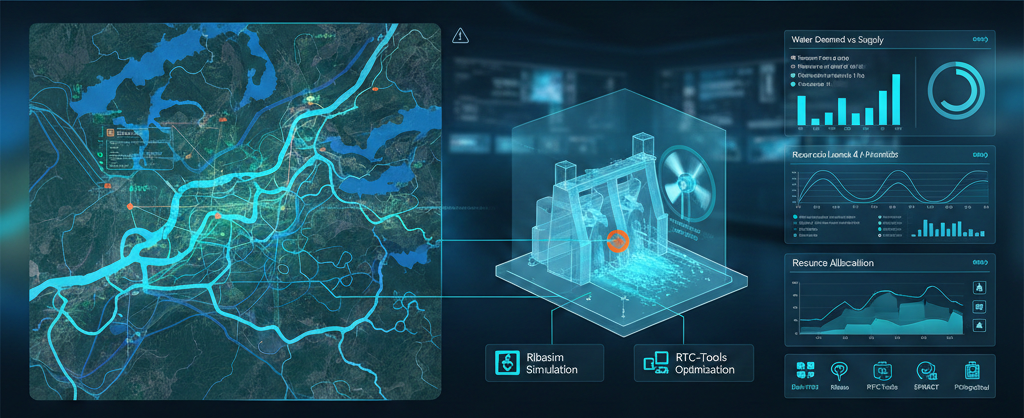
Platform for creating and managing operational digital twins of water infrastructure, powered by Ribasim (Deltares) for river basin management simulation.
What is a Water Digital Twin?
A Digital Twin is a dynamic virtual replica of a real-world water system that continuously updates with operational data. Unlike a static model, a Digital Twin lives and breathes alongside the infrastructure it represents.
From Static Model to Digital Twin
Traditional Model: A static snapshot of the system, updated periodically, used for design and long-term planning.
Operational Digital Twin: A dynamic replica updated in real-time, used for daily operational decisions, optimization, and forecasting.
The GetOpen Platform
GetOpen implements operational Digital Twins based on Ribasim technology by Deltares, the global reference software for river basin management simulation.
Ribasim: Management Simulation
Ribasim (River Basin Simulation Model) simulates the behavior of an entire hydrological basin, considering:
- Available Resources: Natural flows, reservoirs, springs, wells.
- Demand: Potable, irrigation, industrial, environmental, and hydroelectric uses.
- Infrastructure: Dams, canals, pipelines, treatment plants.
- Operational Rules: Allocation priorities, environmental constraints, water rights agreements.
- Climate Scenarios: Droughts, floods, and long-term climate change.
Integration with Delft-FEWS
The Digital Twin is orchestrated by Delft-FEWS, which ensures:
- Automated real-time data acquisition (SCADA, weather, hydrometric).
- Scheduled execution of Ribasim simulations.
- Continuous updates of the digital twin.
- Operational dashboards and automated alerting.
Optimization with RTC-Tools
RTC-Tools (Real-Time Control Tools) by Deltares adds real-time optimization capabilities:
- Optimal reservoir management (maximizing utility while minimizing risks).
- Resource allocation among competing uses.
- Pumping and release scheduling.
- Automated response to critical events.
The Problem We Solve
Water Scarcity Management
In a context of increasing scarcity (climate change, rising demand), water management becomes a multi-objective optimization challenge:
- How to allocate limited resources between potable, irrigation, industrial, and environmental needs?
- When and how much water should be released from reservoirs?
- How to prepare for droughts months in advance?
- How to balance hydroelectric production with potable water availability?
System Complexity
Modern water systems are interconnected networks with hundreds of decision nodes:
- Multiple supply sources.
- Branched transmission and distribution networks.
- Reservoirs and tanks with limited capacity.
- Treatment plants with operational constraints.
The Need for an Integrated Vision
Traditionally, different aspects of water management are handled by separate organizational silos. The Digital Twin provides a unified vision, enabling optimal decision-making across the entire system.
Key Features
1. What-If Scenario Simulation
Question: What happens if next summer is particularly dry? The Digital Twin allows you to simulate:
- A 30% reduction in spring yields.
- A 20% increase in irrigation demand.
- Failure of a primary treatment plant.
- A combination of critical events. Output: An operational plan prepared in advance with specific actions for each scenario.
2. Resource Allocation Optimization
The system calculates the optimal allocation of resources by considering:
- Legal priorities (e.g., Potable > Irrigation > Industrial).
- Environmental constraints (e.g., Environmental Minimum Flow).
- Infrastructural capacities (pipeline limits, treatment capacity).
- Energy costs (scheduling pumping during low-tariff hours).
3. Real-Time Decision Support
Operational dashboards display:
- Current system status (reservoir levels, flows, pressures).
- Short-term forecasts (24-72 hours).
- Medium-term forecasts (1-4 weeks).
- Criticality indicators and automated alerts.
4. Infrastructure Planning
Quantitative evaluation of proposed interventions:
- New reservoirs or expansions.
- Interconnections between systems.
- Wastewater reuse plants.
- Desalination plants.
Target Audience
River Basin District Authorities
Integrated basin-scale resource management with multi-use allocation simulation and decision support during drought periods, improving stakeholder coordination.
Irrigation Consortia
Optimization of irrigation management with demand forecasting per crop and period, distribution scheduling, and efficiency monitoring.
Integrated Water Service Providers
Real-time operational optimization of the water-energy nexus for energy-intensive assets such as pumping stations, drinking water and wastewater treatment plants, and renewable energy production facilities.
Hydroelectric Operators
Balancing energy production with environmental and potable constraints by optimizing releases and maximizing revenue while respecting regulations.
Case Study
Consorzio di Bonifica Emilia Centrale
Development of a Digital Twin for the water infrastructure of the Enza river basin, encompassing existing and planned reservoirs, natural river conveyance, canal networks, diversion weirs, well fields, hydroelectric plants, and civil, industrial, and irrigation withdrawals. The model was calibrated on historical data from 1961 to 2023. The Digital Twin was used for the quantitative cost-benefit assessment of climate adaptation scenarios (new dams, canal lining, weirs, new wells, treated wastewater reuse) under IPCC RCP4.5 and RCP8.5 scenarios with a 2069 horizon.
Regulatory Compliance
- Directive 2000/60/EC: Basin Management Plans with supply-demand balance.
- D.Lgs. 152/2006: Water Balance and Environmental Minimum Flow.
- ARERA 637/2023: Macro-indicator M0 (Supply Resilience).
- Regulation (EU) 2020/741: Assessment of wastewater reuse potential.
Technology: Delft-FEWS, Ribasim, RTC-Tools, EPANET/wntr, PostgreSQL/PostGIS Sectors: Basin Authorities, Water Utilities, Irrigation Consortia, Hydroelectric Operators Compliance: Directive 2000/60/EC, D.Lgs. 152/2006, ARERA 637/2023