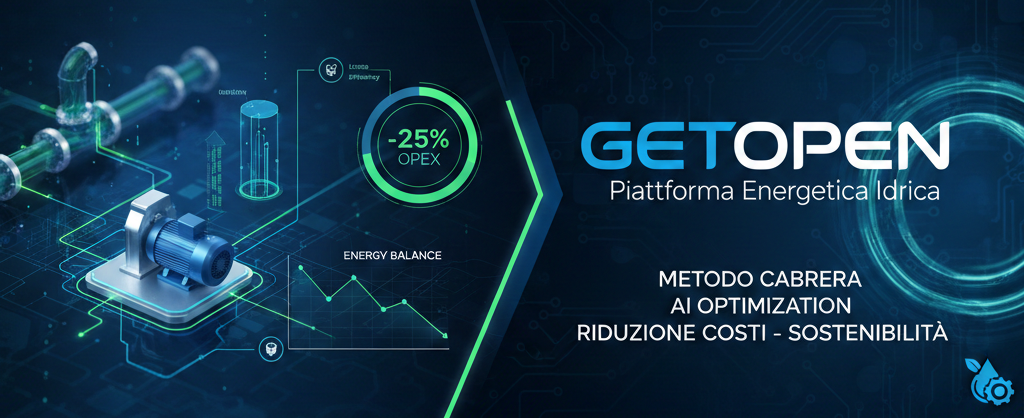
Advanced platform for real-time energy auditing and operational cost optimization using the Cabrera method.
Understanding the Energy Balance in Water Systems
An energy balance in a water system is the systematic analysis of how much energy is used during the abstraction, treatment, and distribution of water. It is the energetic equivalent of a water balance: just as a water balance tracks volumes, an energy balance tracks energy flows.
Water is Not Just Water: the Water-Energy Nexus
Every cubic meter of water transported carries an associated energy cost. Energy consumption in a water system is broken down into:
- Useful Energy: Effectively delivered to end-users.
- Energy Dissipated by Friction: Lost due to friction within pipes.
- Energy Lost through Water Leakage: Entirely wasted.
- Pumping Inefficiencies: Pumps operating far from their Best Efficiency Point (BEP).
The GetOpen Platform: A Cyber-Physical System
A solution that integrates the physical world (SCADA measurements, sensors) with the digital world (hydraulic models, optimization algorithms) to create an intelligent energy management system.
The Problem We Solve
The water sector is among the most energy-intensive: water lifting and transport account for approximately 3-4% of national electricity consumption in many industrialized countries.
High and Rising Energy Costs
Electricity accounts for 15-30% of total management costs for average utilities, rising to 50-60% for systems requiring significant lifting.
Hidden Inefficiencies
Centrifugal pumps lose efficiency over time due to wear (cavitation, impeller erosion). Without continuous monitoring, this degradation is silent and generates significant waste.
Energy “Thrown Away” with Leaks
Every liter of water lost has already been pumped using energy. A system with 30% leakage and 0.6 kWh/m³ specific consumption wastes approximately 1.8 GWh/year solely on the energy used to pump leaked water.
The Solution: Cabrera Method + Delft-FEWS + wntr
The Cabrera Method: Scientific Foundation
Enrique Cabrera (Polytechnic University of Valencia) developed a rigorous methodology to decompose energy in water systems:
E_input = E_useful + E_friction + E_leakage + E_inefficiency
The platform automatically calculates each component by integrating electrical data (power meters, inverters), hydraulic data (flows, pressures, levels), and topological data (GIS network, pump curves).
Automated Energy Balance Calculation
Daily automated calculations for each pumping station and the entire system: energy consumed, theoretical minimum energy, overall efficiency, and specific consumption (kWh/m³).
Actual Pump Curve Profiling
Automated construction of actual operational characteristic curves through continuous data acquisition. Compare real-time performance against nominal curves to proactively identify inefficient pumps before failure.
Pumping Set-Point Optimization
Automated calculation of the optimal set-point for each pump: the system simulates all possible combinations to select the one that minimizes energy costs while respecting operational constraints.
Energy-Water Nexus with wntr
The wntr toolkit simulates the impact of hydraulic interventions on energy consumption, providing ex-ante quantitative evaluations of leak reduction and pressure management.
Tariff Optimization (Peak Shaving)
Scheduling pumping preferentially during off-peak hours (e.g., night-time) with typical savings of 5-15% on energy procurement costs.
KPI Monitoring and Automated Compliance
Real-time dashboards featuring key indicators (specific consumption, global efficiency, specific cost), automated alerts, and audit reports compliant with ISO 50001 and local regulations (e.g., IT D.Lgs. 102/2014).
Regulatory Compliance
- ISO 50001: Energy Management Systems.
- Directive 2012/27/EU: European Energy Efficiency framework.
- National Mandates: Mandatory energy audits for large/energy-intensive companies.
- ESG Criteria: Sustainability reporting and CO₂ emission reduction.
Case Study
Valle Umbra Servizi
Pilot implementation of a Water Management System for automatic hourly water balance of a DMA, acquisition of end-user consumption data from a smart metering platform integrating noise sensors, integration with the SCADA/telecontrol system and the hydraulic network model, processing of noise and pressure correlations, minimum night flow analysis, and water and energy balance computation.
Technology: Delft-FEWS, USEPA/wntr, Cabrera Algorithms, PostgreSQL/TimescaleDB Sectors: Water Utilities, Irrigation Consortia, Energy Managers, ESCos Compliance: ISO 50001, EU Directive 2012/27, National Energy Regulations