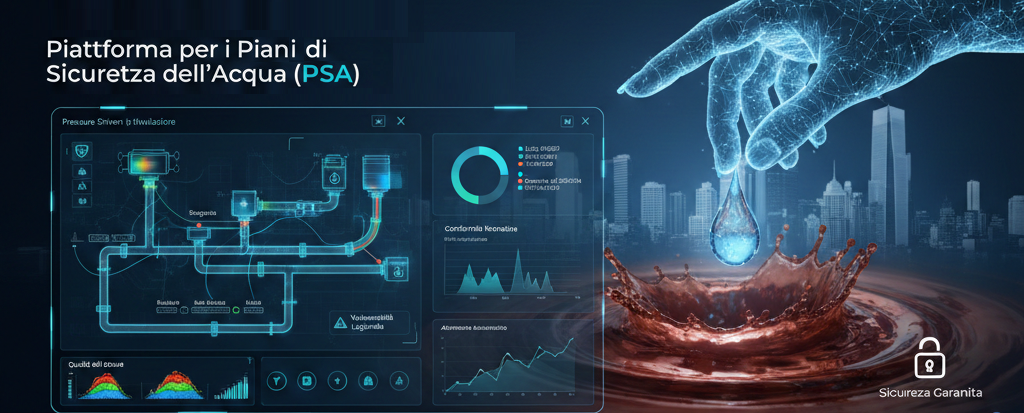
Advanced platform for preventive risk analysis and their continuous updating, quality modeling, and drinking water emergency management in compliance with EU Directive 2020/2184.
What is a Water Safety Plan (WSP)?
A Water Safety Plan (WSP) is a systematic and preventive approach to ensuring the safety of water intended for human consumption, from the source to the point of use.
Paradigm Shift: From Reactive to Preventive
Traditional approaches relied on retrospective testing—identifying non-compliance only after the water had already been distributed. The WSP approach, mandated by current regulations, introduces preventive control, where risks are identified and mitigated before they occur.
The GetOpen WSP Platform
An enterprise software solution that digitizes and automates the entire lifecycle of a Water Safety Plan, transforming it from a static paper document into a dynamic operational system.
Decision Support System (DSS)
The platform integrates:
- Orchestrator: Delft-FEWS for workflow coordination and integration of geographic data and external sources (SCADA, IoT, water quality sampling).
- Hydraulic Engine: EPANET 2.2 for water network simulations.
- Resilience Engine: USEPA/wntr for vulnerability analysis and stress-testing.
- Geographic Database: PostgreSQL/PostGIS for localized infrastructure mapping.
The Problem We Solve
With the enforcement of Directive (EU) 2020/2184, water managers face unprecedented challenges:
Extended Responsibility
The manager’s responsibility extends across the entire water supply chain, including abstraction, treatment, storage, and the distribution network up to the meter.
Mandatory Preventive Approach
Regulations require the identification and assessment of all risks along the entire chain: catchment, treatment, distribution, and domestic phases.
Data Integration at Scale
Laboratory data, GIS, SCADA/IoT, customer registries, meteo-hydrological data, and maintenance records must be integrated into a consistent and updated risk model.
Continuous Mandatory Updates
WSPs require periodic reviews (typically every 3 years), immediate updates following critical events, and continuous monitoring of the effectiveness of control measures.
The Solution: Delft-FEWS + USEPA/wntr
Hydraulic and Quality Modeling
EPANET 2.2 simultaneously simulates hydraulics (flows, pressures, levels) and quality (residual chlorine, water age, tracers, contaminants).
USEPA/wntr (Water Network Tool for Resilience) is an advanced extension of EPANET focused on water service resilience assessment, failure analysis, extreme scenario simulation, and risk evaluation.
Dynamic Risk Analysis
The platform integrates multi-source data to automatically detect risk events through continuous monitoring of critical parameters (residual chlorine, turbidity, pressure, conductivity, pH) and correlation with contextual data.
Vulnerability and Resilience Analysis
The wntr toolkit provides advanced algorithms for Vulnerability Analysis (identifying critical nodes), Resilience Metrics (Todini Index, Tank Capacity, Entropy), and Contaminant Scenario Analysis.
Operational Emergency Management
In the event of a critical incident, the platform supports real-time operational decisions: impact simulation, containment option evaluation, recovery time calculation, and flush-out optimization.
Automated Reporting and Compliance
Automated generation of WSP reports compliant with WHO WSP Guidelines and EU JRC guidance documents, with multi-level operational dashboards (for managers, health authorities, and regulators).
Regulatory Compliance
- Directive (EU) 2020/2184: European framework for drinking water quality, mandating WSP implementation, risk management, and continuous monitoring.
- WHO Water Safety Plan Guidelines: International framework and methodology for WSP development.
- EU JRC – Water Security Plan Implementation Manual: Operational technical standards for WSPs.
- EU JRC – Guidance for Water Security Plans: EU-level guidance for risk-based water safety management.
- Applicable National Regulations: National transpositions of Directive (EU) 2020/2184 and related water quality standards.
- Technical Quality Indicators: Monitoring of water quality and supply resilience.
Technology: Delft-FEWS, USEPA/wntr, EPANET 2.2, PostgreSQL/PostGIS Sectors: Water Utilities (SII) Compliance: EU Directive 2020/2184, WHO WSP Guidelines, EU JRC Guidance, National Water Quality Regulations